Listen to article
An AI visibility audit is the process of evaluating how often and how accurately a brand, website, or content appears in AI-generated search results from platforms like ChatGPT, Google AI Overviews, Perplexity, and Gemini.
Why is this important?
Because while companies are increasingly realizing the importance of AI search engine optimization, many don’t know whether they’re being recommended, ignored, or missing valuable citation opportunities.
In this guide, we’ll walk you through an 8-step process for measuring your brand’s presence across AI search platforms, including analyzing responses for accuracy, testing unbranded queries, and more.
What an AI Visibility Audit Actually Measures
When done right, an AI search visibility audit can show you where your brand is gaining traction, where visibility gaps exist, and what steps you can take to increase your presence across AI-powered search platforms.
The secret? Knowing which metrics to track and what platforms to include in your strategy.
The Five Core Metrics
Visibility audits cover five core metrics that help quantify and evaluate your brand’s presence in AI-generated responses:
- Citation Count: The total number of times your brand, website, or content is cited or referenced in AI-generated responses.
- Share of Voice: The percentage of mentions your brand receives compared to competitors across a selected set of AI-generated answers.
- Sentiment: The overall tone of AI-generated mentions of your brand, whether positive, neutral, or negative.
- Prompt Coverage: The number or percentage of relevant prompts for which your brand appears in the AI-generated response.
- Recommendation Rank: The position at which your brand is mentioned when AI platforms provide a list of recommendations or options.
Measuring visibility in AI search can be challenging because answers often vary across runs, prompts, and time periods. With one-off observations providing only a limited snapshot, GEO tools help streamline this process by monitoring visibility, tracking brand mentions, and more.
Which Platforms to Include
A comprehensive AI visibility audit should include ChatGPT, Perplexity, Gemini, and Google AI Overviews. Because each platform generates answers differently, your brand’s visibility can vary across them.
- ChatGPT: Primarily draws on trained knowledge and web retrieval capabilities to generate responses.
- Perplexity: Relies heavily on live web retrieval and cited sources.
- Gemini: Combines AI-generated responses with Google’s search ecosystem and real-time information.
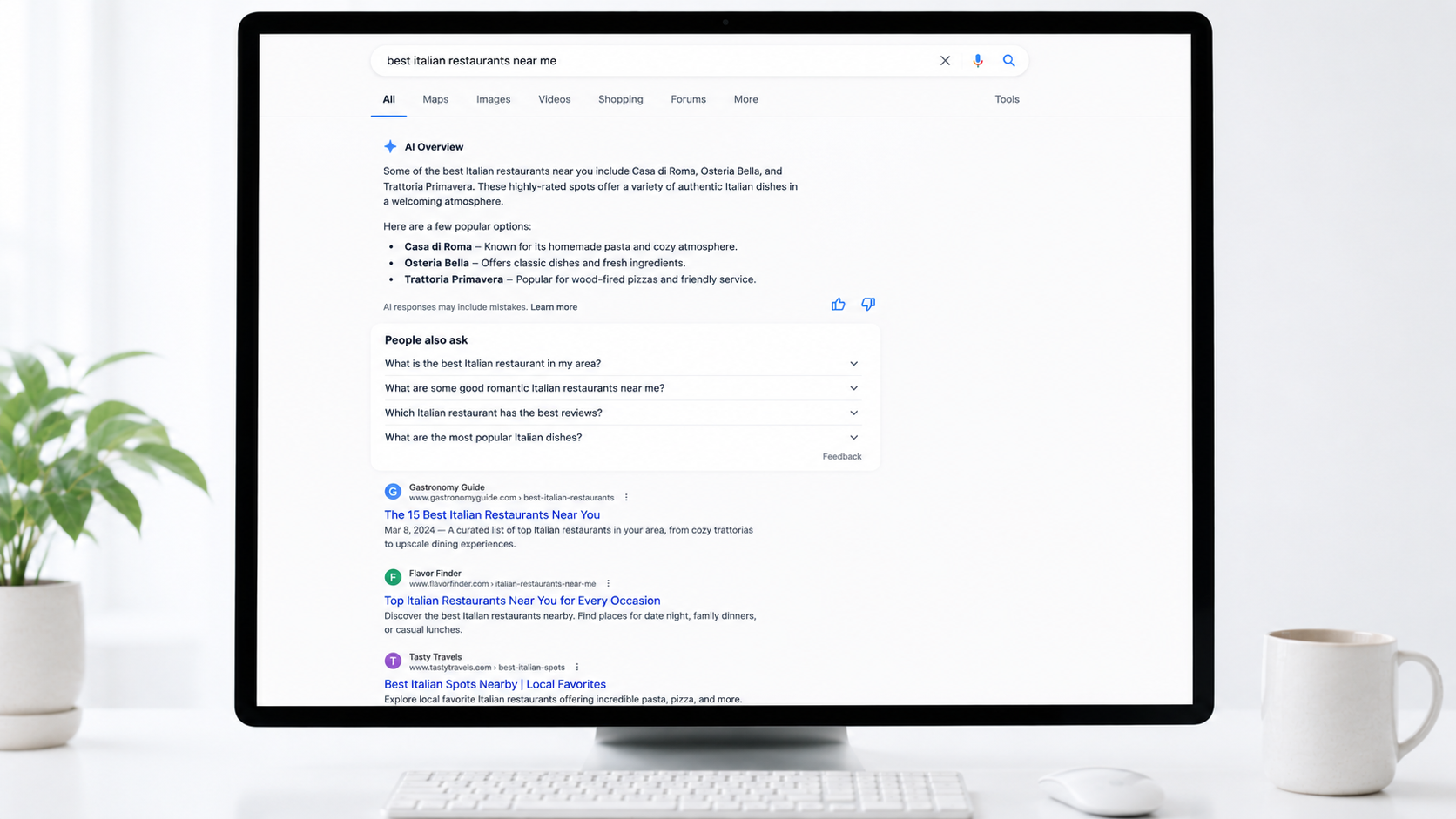
- Google AI Overviews: Creates search summaries using content from authoritative webpages and grounded citations.
Many businesses focus only on ChatGPT, but that’s not necessarily where all of your potential customers are searching. Auditing all four platforms gives you a more complete picture of your brand’s AI visibility and helps you spot opportunities that could be missed if you only monitor one platform.
Step 1: Define the Scope of Your AI Visibility Audit
The first step of an AI visibility audit is to define your scope. Here’s what you should know.
Choose Your Query Set
Queries are divided into two groups: branded and unbranded.
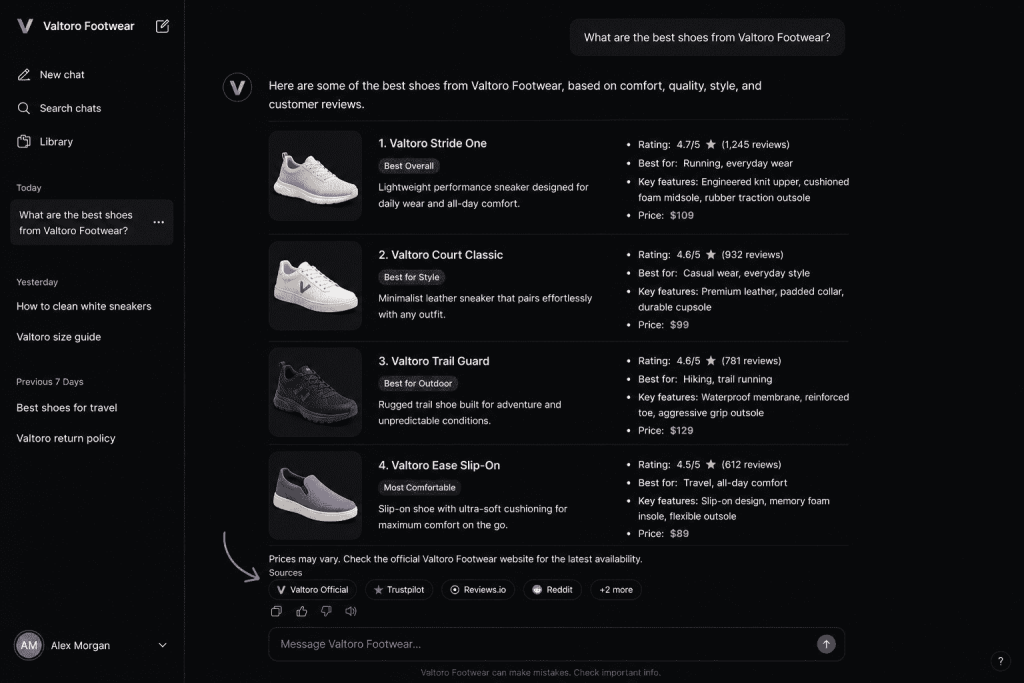
Branded queries include your company name, product names, and, where relevant, key personnel. For example, a shoe company might use prompts such as “Is [Brand Name] a good shoe company?” or “What are the best shoes from [Brand Name]?” to evaluate how AI platforms describe and recommend the brand.
Unbranded queries, on the other hand, focus on broader product categories or topics where you want your brand to appear. For the same shoe company, relevant prompts might include “What are the best running shoe brands?” or “Which shoe brands are best for marathon training?” to determine whether the brand is being recommended alongside competitors for relevant searches.
Defining your scope upfront is important because it keeps your audit manageable and focused. Auditing 20 to 50 carefully selected prompts is realistic for a manual review, but trying to analyze hundreds of prompts quickly becomes time-consuming and difficult to maintain without dedicated AI visibility tools.
Pick Your Competitor Set
Comparing your results to competitors helps you understand whether you’re showing up as often as they are or if they’re winning visibility in areas where your brand is missing out.
To get meaningful insights, choose three to five direct competitors to benchmark against. Look for companies that target the same audience, offer similar products or services, and regularly appear in AI-generated recommendations.
This gives you a realistic point of comparison and helps you spot opportunities to improve your visibility, citations, and share of voice.
Step 2: Benchmark Your Current Brand Visibility in AI Search
A key part of an AI search visibility audit is creating a baseline that you can compare against over time. In this step, you’ll focus on branded prompts to see how AI platforms currently talk about your brand.
Run Your Branded Prompts
It’s time to put your branded queries to work. One of the most important things to remember is that AI responses can vary from one session to the next, so don’t rely on a single result.
Instead, run each prompt, run them again, and then run them again. To reduce personalization, do this in new sessions; this helps you get a more accurate picture of how AI platforms typically describe, recommend, and cite your brand.
Record Your Baseline Scores
Now that you’ve run your branded prompts, it’s time to start tracking the results. Creating a baseline makes it easier to measure progress over time and identify whether your visibility is improving or declining.
For each prompt, record:
- Whether your brand was mentioned (Yes/No)
- Your brand’s position in the response (1st, 2nd, 3rd, etc.)
- Whether a citation or link was included (Yes/No)
- The overall sentiment (Positive, Neutral, or Negative)
A simple spreadsheet is usually all you need to get started. Create a row for each prompt and a column for each metric so you can easily compare results across platforms and over time.
To establish a reliable baseline, aim to track at least 10 branded prompts per platform.
Step 3: Analyze Branded AI Responses for Accuracy and Sentiment
Don’t take AI search responses at face value; take the time to evaluate them carefully. As part of your visibility audit, review both factual accuracy and sentiment to understand how clearly and correctly your brand is being presented.
Check Factual Accuracy
AI tools may say something factually incorrect about your brand. If so, don’t ignore it.
If you notice wrong pricing, discontinued products, incorrect founding dates, outdated services, or even misattributed quotes, flag them in your audit. These errors can shape how potential customers understand your brand, even when the information is inaccurate.
Since these inaccurate outputs can persist over time, you can correct them by focusing on strengthening your AI content authoritative signals. This includes your website, review platforms, social media, and discussion forums like Reddit.
Score the Sentiment
Rate each AI response based on its sentiment. A positive score means your brand was described favorably or recommended. Neutral means it was mentioned without any clear evaluation, while a negative score means your brand was described unfavorably or not recommended when competitors were.
As you review responses, look for patterns rather than focusing on individual mentions. By the end of this step, you should have a sentiment score for each prompt response and a clear sense of the dominant sentiment pattern across platforms.
Step 4: Test Unbranded Queries and Topic Associations
It’s not uncommon for there to be a gap between where a brand thinks it stands and where AI models actually place it. A brand may rank well in Google but have little to no unbranded AI share of voice.
This is exactly where unbranded queries become important.
Run Category-Level Prompts
As mentioned earlier, unbranded queries focus on product categories rather than your brand name.
At this stage, you should be asking questions such as “What are the best [product category] tools for [use case]?” or “Who are the top providers of [service] for [audience]?”
As part of your AI search visibility audit, run these queries across ChatGPT, Perplexity, Gemini, and Google AI Overviews, then record which brands are recommended, how often they appear, and where they rank in the response.
This is often where visibility gaps become apparent. A brand may perform well in traditional search results yet rarely appear in AI-generated recommendations for the categories it wants to be associated with.
If you’re wondering how generative engines choose sources, the exact process varies by platform. However, common factors include relevance to the query, source credibility, and information recency.
Map Your Share of Voice
Once you’ve collected your unbranded query data, it’s time to calculate your share of voice, the percentage of relevant unbranded prompt responses in which your brand appears.
Use this formula:
(Brand Mentions ÷ Total Prompt Responses Tested) × 100
For example, if your brand appears in 15 out of 50 responses, your share of voice is 30%.
Be sure to calculate this metric for your brand and each competitor in your benchmark set to see who is earning the most visibility in AI-generated recommendations.
Step 5: Find Which Pages Are Being Cited in AI Responses
Step 5 of your visibility audit is to examine which pages are earning citations and determine whether there are opportunities to improve your own chances of being cited.
Identify Your Cited URLs
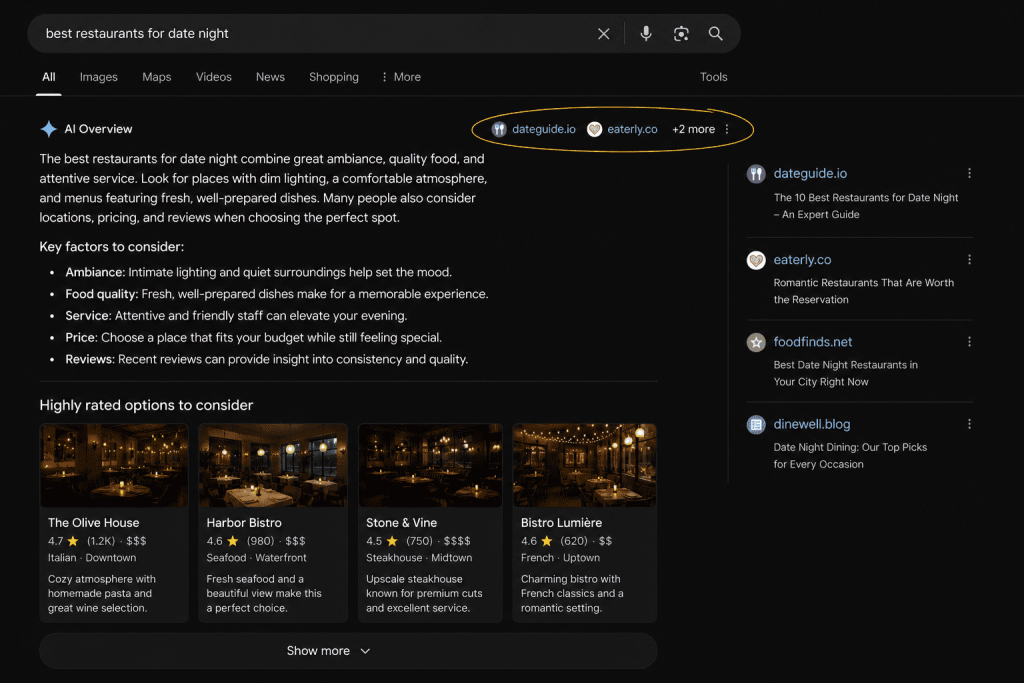
Don’t just track your results and those of your selected competitors. Pay attention to the websites and companies that appear in citations, especially in Perplexity and Google AI Overviews, which are the platforms most likely to surface sources explicitly.
This can help you uncover competitors and authoritative sources that weren’t originally on your radar.
As you review responses, log the URL, the prompt that triggered the citation, and how often the source appears across your prompt set.
Diagnose Pages Not Getting Cited
Is your content ranking in traditional search but not appearing in AI citations?
If so, you may be missing signals that AI platforms rely on, such as structured data, clear author attribution, authoritative mentions, or direct answers to prompt-style questions.
This may be a sign that it’s time to prioritize LLM optimization. Focus on using natural, question-based language, keeping content up to date, improving its value as a reference source, and structuring information clearly so AI platforms can more easily understand and cite it.
At Scopic Studios, our GEO services focus on optimizing your online content to increase visibility across AI-generated search results and recommendations. Contact our team to learn how we can help your content earn more citations and visibility in AI search.
Step 6: Identify Sentiment Drivers and Brand Mention Context
By this point, you’ve measured how often your brand appears and how those mentions are scored. Now it’s time to understand the context behind those mentions and the narratives AI platforms are associating with your brand.
Review Context Surrounding Mentions
Don’t just count brand mentions; look at how your brand is being described. Read the sentence or paragraph surrounding each mention and pay attention to the language AI platforms use.
For example, is your brand being positioned as an industry leader, a budget-friendly option, a niche provider, or an alternative to a larger competitor? These distinctions matter because they shape how users perceive your company.
The framing of a mention can be just as important as the mention itself. A brand that appears frequently but is consistently positioned as a secondary option may have a different visibility challenge than one that appears less often but is presented as a top recommendation.
For ongoing monitoring, consider using dedicated AI brand monitoring tools to track how AI platforms describe your brand over time.
Spot Recurring Narrative Patterns
As you review responses, look for descriptions that appear repeatedly across prompts and platforms.
For instance, AI platforms may consistently describe a company as “a good option for small teams,” “enterprise-focused,” or “best for startups.” When the same qualifier appears multiple times, it can reveal how AI models have learned to frame your brand.
These patterns are worth documenting. They may reflect strengths you want to reinforce, or they might highlight content gaps and messaging mismatches that are influencing how AI platforms interpret and recommend your business.
Step 7: Benchmark Your Brand Against Competitors
By now, you’ve collected plenty of data. Step 7 of your AI search visibility audit is to compare those findings against your competitors and see where your brand stands.
Run the Same Prompts for Each Competitor
Remember when we said you’d need to run prompts again and again?
Now it’s time to put that into practice. Run the same branded and unbranded prompt sets for each competitor in your benchmark group. Keeping the prompts consistent ensures you’re making fair comparisons across brands and platforms.
Record each competitor’s citation count, share of voice, sentiment score, and recommendation rank using the same logging format established in Step 2. This will help you identify who’s earning the most visibility and where your brand stands in comparison.
As your audit grows, AI visibility audit tools can help automate prompt tracking and reporting. Check out our head-to-head tool comparison for a closer look at two popular options.
Build a Side-by-Side Comparison
The next step is to build a side-by-side comparison.
Create a simple table with your brand and each competitor listed in the rows and the five core metrics from Step 1 in the columns:
- Citation Count
- Share of Voice
- Sentiment
- Prompt Coverage
- Recommendation Rank
Using the data you’ve collected so far, fill in the table for each brand. This makes it easier to spot patterns, identify your company’s strengths and weaknesses, and see where competitors may be outperforming you.
Once your table is complete, focus on the metrics with the largest gaps. These differences can help highlight where your brand has the greatest opportunities to improve its AI visibility and recommendations.
Step 8: Turn Audit Findings Into an AI Visibility Strategy
Your AI visibility audit is a great starting point, but it’s only valuable if it’s followed by a clear action plan.
Prioritize Your Gaps
Not every issue uncovered during your audit deserves the same level of attention. To make the most of your findings, prioritize gaps based on their potential impact.
A simple framework is:
- High Priority: Fix inaccurate AI outputs that could harm your reputation or mislead potential customers.
- Medium Priority: Address low unbranded share of voice in high-value query categories where you want to be recommended.
- Long-Term Priority: Improve sentiment and brand positioning to influence how AI platforms describe and frame your business.
This approach helps ensure you’re tackling the issues that are most likely to affect visibility, trust, and growth first.
Map Actions to Content and Source Fixes
Once you’ve identified your biggest gaps, connect them to the actions needed to address them.
- Factual inaccuracies: Update authoritative content on your website and strengthen third-party citations to improve information accuracy.
- Low citation rates: Improve content structure, add relevant schema markup, and create clearer, more direct answers to common questions.
- Share of voice gaps: Develop content targeting the prompt categories where competitors appear but your brand does not.
If you’re looking for a more systematic approach, LLM optimization and GEO strategies can help improve your chances of being cited, recommended, and accurately represented by AI platforms.
AI visibility audit tools can also help automate ongoing monitoring by re-running prompts, tracking citations, and measuring changes over time. Rather than treating visibility as a one-time project, consider repeating your audit quarterly to monitor progress and identify new opportunities as AI search continues to evolve.
Need help putting your audit findings into action? At Scopic Studios, our GEO experts can help you improve AI visibility, strengthen citation opportunities, and increase your presence across platforms like ChatGPT, Gemini, Perplexity, and Google AI Overviews.
Contact us to get your free AI visibility audit.
FAQs About AI Visibility Audits
What is an AI visibility audit?
An AI visibility audit measures how often, how accurately, and how favorably a brand appears in AI-generated search responses across platforms like ChatGPT, Perplexity, Gemini, and Google AI Overviews. It helps businesses understand their AI search presence and identify opportunities to improve citations, recommendations, and overall visibility.
How is an AI visibility audit different from a traditional SEO audit?
Traditional SEO audits focus on factors such as Google rankings, crawlability, backlinks, and technical website performance. An AI visibility audit measures citation frequency, share of voice, sentiment, and recommendation visibility within AI-generated answers, which rely on different signals than traditional search engines.
To learn more about the differences, check out our guide on AI visibility tools vs traditional SEO tools.
How long does an AI visibility audit take to complete?
A manual AI visibility audit covering 10 to 15 prompts across three platforms typically takes between two and four hours. The timeline can increase depending on the size of the prompt set, the number of competitors being analyzed, and whether the process is performed manually or with the help of automation tools.
Which AI platforms should I include in an AI visibility audit?
The four core platforms to include are ChatGPT, Perplexity, Gemini, and Google AI Overviews. Each platform surfaces brand information differently due to variations in training data, live retrieval methods, and citation practices, making it important to evaluate all four for a complete picture of your visibility.
How often should I run an AI visibility audit?
For most businesses, running an AI visibility audit once per quarter is a good baseline. However, major AI model updates, significant changes to your content strategy, or notable competitor activity may justify conducting an audit sooner.
About AI Visibility Audit Guide
This guide was authored by Baily Ramsey, and reviewed by Sonja Somborac, SEO Specialist at Scopic Studios.
Scopic Studios delivers exceptional and engaging content rooted in our expertise across marketing and creative services. Our team of talented writers and digital experts excel in transforming intricate concepts into captivating narratives tailored for diverse industries. We’re passionate about crafting content that not only resonates but also drives value across all digital platforms.