

Listen to article
We’ve all been there: a marketing strategy that looks great on paper but fails to deliver measurable business impact. After all, CFOs aren’t asking how many leads a campaign is generating; they want to know how much revenue it produced.
And with 79% of leads failing to convert into sales, it’s not uncommon for marketing teams to struggle to connect their activities to revenue.
Revenue marketing closes this gap. It reorients SEO, PPC, content, and lead generation around a single question: How much revenue is each activity generating?
This guide provides a practical framework for revenue-driven marketing, helping companies tie each marketing channel to pipeline and revenue outcomes, including channels such as SEO, PPC, and more.
What Is Revenue Marketing? (And How It Differs from Demand Gen)
Revenue marketing is a strategic approach that uses SEO, PPC, content, and other marketing activities to generate measurable revenue. Put simply, it connects every channel to pipeline while holding marketing accountable to the same metric the sales team is measured on: closed revenue.
Understanding the true revenue marketing definition is key to understanding how it differs from demand generation.
Demand generation consists of marketing strategies that build on brand awareness efforts to educate target audiences and generate leads. As a result, it’s measured by leads and MQLs rather than pipeline and closed revenue.
So, while someone focused on demand generation may ask, “How many leads did we generate?” a revenue marketing professional would be expected to answer questions like, “How much revenue did those leads turn into, and which channels produced it?”
However, revenue-driven marketing isn’t meant to replace demand generation. In fact, it builds on it. The image below shows the progression and highlights how each stage adds accountability.
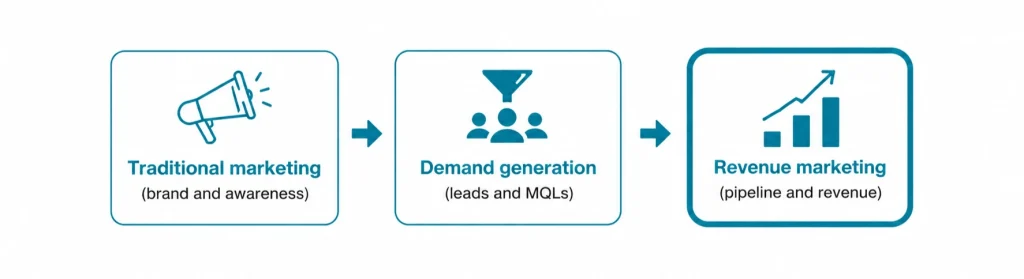
The Revenue Marketing Model: From Channel Activity to Closed Revenue
Before we go channel by channel and explore how different strategies connect to pipeline and revenue, there’s one important thing to clarify: revenue marketing isn’t a new channel or tactic. It’s a framework for measuring how marketing activities contribute to business growth and revenue.
Think of it this way: SEO, PPC, content marketing, email campaigns, and lead generation efforts all play a role in moving prospects through the buying journey. Revenue marketing connects those activities to business outcomes, making it easier to understand which channels are influencing pipeline and generating revenue.
Rather than viewing marketing as a collection of disconnected activities, revenue marketing treats the customer journey as a connected chain. Every channel activity should map to a funnel stage, and every funnel stage should connect to a revenue-linked metric.
The revenue marketing model typically looks something like this:
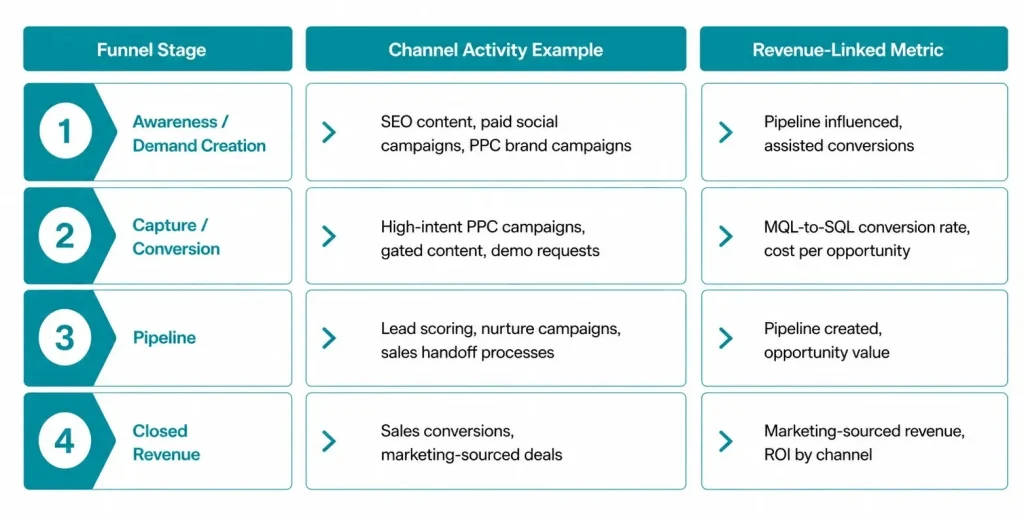
How to Tie SEO, PPC, and Lead Gen to Pipeline
Aligning marketing metrics with business revenue goals starts with understanding how marketing activities contribute to revenue. Below, we look at how to connect SEO, PPC, and lead generation efforts to pipeline and revenue outcomes.
Tying SEO and Content to Revenue
It’s no secret that it’s hard to track SEO efforts back to revenue. Not because SEO isn’t valuable, but because it’s typically measured by rankings and traffic. A blog post may be on the first page of Google, and it may even be read by someone early in the funnel who doesn’t make a purchase until months later.
So how do we measure these efforts?
Consider the following as you’re learning how to tie SEO and content marketing to revenue goals:
- Connect content to pipeline based on search intent. Map each piece of content to a funnel stage: top-of-funnel awareness content (influences pipeline) and bottom-of-funnel comparison, alternative, and solution-focused content (converts pipeline). Tag and track them differently; they serve different purposes and should be measured against different revenue metrics.
- Track assisted conversions, not just last-click conversions. SEO’s revenue contribution is often tied to influence and assistance rather than direct conversion. Set up multi-touch attribution (even basic UTM tracking combined with a CRM that records first-touch and last-touch interactions) so the blog post that started the journey receives credit, not just the demo page that closed the deal.
- Focus on revenue-driven SEO metrics. The metrics that matter include organic pipeline influenced, organic-sourced revenue, content-assisted conversions, and revenue per keyword cluster. In other words, identify which content topics generate pipeline and revenue, not just traffic.
- Use the right tools to connect SEO to revenue. GA4, CRM integrations, conversion tracking, and UTM governance can help connect website activity to deal stages and closed revenue. The good news is that you don’t need an expensive enterprise platform to get started.
Tying SEO to revenue requires a strategy built around search intent, attribution, and business outcomes. With Scopic Studios’ SEO services, you can connect organic search performance to pipeline and revenue growth.
Tying PPC and Paid Media to Revenue
At first glance, PPC is one of the easiest channels to track. However, many companies focus on clicks rather than actual revenue. When teams optimize for cost per lead, they may end up celebrating cheap leads that never close.
Here are some tips for generating pipeline and revenue metrics that not only look good but also resonate with CFOs:
- Optimize for cost per opportunity, not cost per lead. A $40 lead that never progresses beyond the lead stage is more expensive than a $200 lead that closes. To improve results, push your optimization metrics further down the funnel and feed CRM conversion data back into ad platforms through offline conversion tracking. This helps algorithms optimize for revenue rather than clicks.
- Separate brand and non-brand spend in revenue reporting. Brand PPC often captures existing demand, resulting in higher ROAS but lower incremental impact. Non-brand PPC, on the other hand, helps generate new pipeline and expand market reach. Reporting them together can make it difficult to understand what’s actually driving growth.
- Focus on revenue-driven PPC metrics. The metrics that matter include cost per opportunity, pipeline created by channel, marketing-sourced revenue from paid campaigns, ROAS based on closed revenue rather than lead volume, and customer acquisition payback period.
- Close the loop between advertising and revenue data. Offline conversion tracking, CRM integrations, a consistent UTM structure, and closed-loop reporting can help connect ad spend to opportunities, closed deals, and revenue outcomes.
Like SEO, PPC delivers the most value when it’s measured against business outcomes rather than campaign-level metrics alone. Businesses that invest in professional PPC services can often gain better visibility into how paid media contributes to overall marketing ROI.
Tying Lead Generation to Pipeline and Revenue
Lead generation is often where teams have the most hope for revenue generation. However, leads don’t equal revenue, meaning you may hit your MQL target while missing your revenue expectations.
This doesn’t mean you can’t optimize your strategy; it just means you need to know how to:
- Shift the goal from lead volume to qualified pipeline. Redefine the marketing target around SQLs and pipeline created, not raw MQL count. This single change reorients the entire lead generation program around revenue.
- Build the lead-to-revenue feedback loop. The most important and often most-skipped step is closing the loop between marketing-generated leads and closed deals in the CRM. This allows marketing teams to see which lead sources, campaigns, and content actually produce revenue.
- Tie lead scoring to revenue behavior, not just activity. Score leads based on fit and intent signals that correlate with closing, not just email opens or content downloads. A lead that downloads three whitepapers but never books a demo is showing activity, not necessarily intent.
- Focus on revenue-driven lead generation metrics. The metrics that matter include MQL-to-SQL conversion rate, SQL-to-opportunity rate, pipeline created from marketing leads, marketing-sourced and marketing-influenced revenue, and average deal size by lead source.
- Use the right tools to track leads through revenue. A CRM with closed-loop reporting, a revenue-focused lead scoring model, and source attribution captured at form fill can help teams follow each lead from first touch to closed-won revenue. Lead generation services also help companies improve lead quality, streamline qualification, and create a more reliable path from lead acquisition to revenue.
Marketing Revenue Attribution: Which Model Actually Works
Which marketing channels are actually contributing to revenue?
That’s where marketing revenue attribution comes in. Attribution models help businesses understand how marketing activities contribute to pipeline and revenue. The challenge is that no attribution model is perfect, and each comes with trade-offs.
- First-touch attribution gives all credit to the channel that introduced the prospect to your business. It’s useful for understanding demand creation but tends to overcredit top-of-funnel channels.
- Last-touch attribution assigns all credit to the final interaction before conversion. While simple and widely used, it often undercredits channels like SEO and content marketing that influenced the buyer earlier in the journey.
- Multi-touch attribution distributes credit across multiple interactions. For most B2B companies, a W-shaped model provides a practical balance by assigning greater weight to three key milestones: first touch, lead creation, and opportunity creation.
- Another important distinction is marketing-sourced revenue versus marketing-influenced revenue. Marketing-sourced revenue comes from leads originally generated by marketing, while marketing-influenced revenue includes any deal where marketing played a role during the buying journey. Both metrics matter because they tell different stories about marketing’s contribution to revenue.
It’s important to remember that perfect attribution doesn’t exist. Buyers interact with colleagues, communities, review sites, and other channels that analytics platforms can’t fully track. The goal isn’t perfect attribution; it’s a consistent and defensible model that helps your team better understand marketing’s contribution to revenue. This leads to more informed investment decisions.
For organizations looking to improve attribution without investing in complex software, combining a multi-touch attribution model with self-reported questions such as “How did you hear about us?” often provides enough visibility to connect marketing efforts to pipeline and revenue.
The image below illustrates how the W-shaped attribution model works:
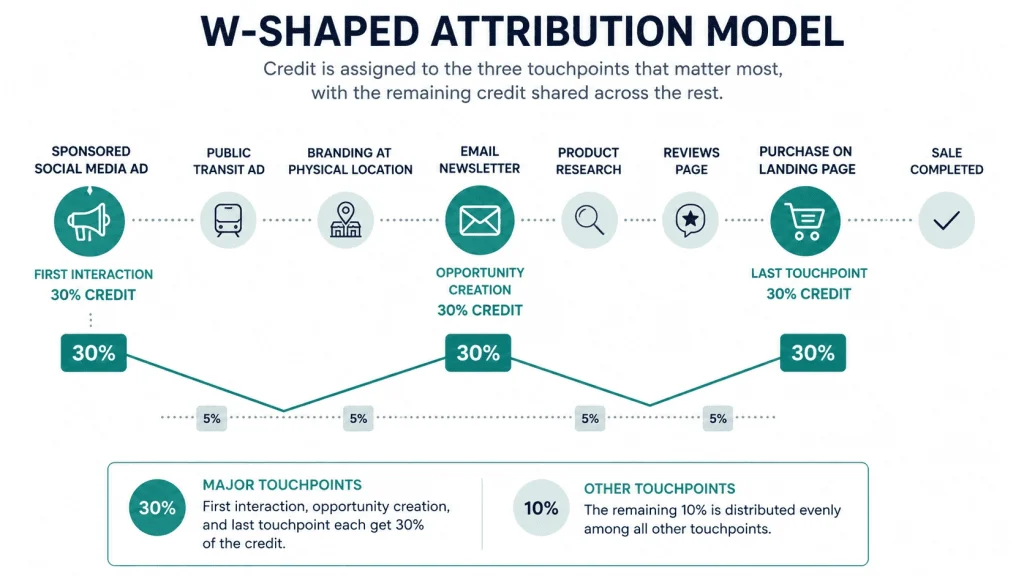
Revenue Marketing Metrics: Aligning Marketing with Business Revenue Goals
If you’re not sure how to measure marketing contribution to revenue growth, you’re not alone.
Many marketing teams still focus on metrics such as traffic, rankings, impressions, and lead volume. While these metrics can help evaluate campaign performance, they don’t always show how marketing impacts the bottom line.
The key to aligning marketing metrics with business revenue goals is to stop leading with activity metrics and start leading with revenue metrics.
The image below highlights the difference.
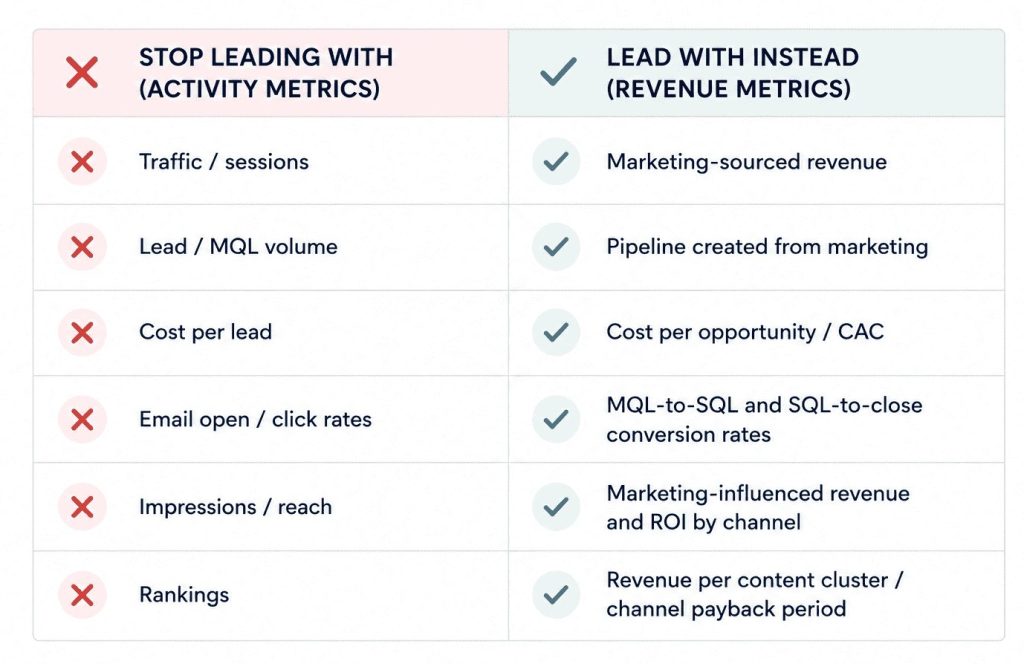
We should note that activity metrics still have value, as they help diagnose performance and identify opportunities for improvement. The mistake? Relying on them as the primary measure of success.
How to Build a Revenue Marketing Strategy: A Step-by-Step Approach
By now, we’ve talked a lot about revenue marketing. But understanding which metrics to track is only part of the equation. You also need a strategy that connects marketing activities to pipeline and revenue.
Here are the five steps you should follow:
- Make sure marketing and sales agree on what a qualified lead looks like.
Many revenue marketing challengesstart here. If marketing and sales have different definitions of a qualified lead, every metric that follows becomes harder to trust. Before focusing on attribution or reporting, get both teams aligned on what qualifies as an SQL. - Set upclosed-loopreporting.
If you can’t connect lead sources to closed revenue, you can’t accurately measure marketing’s impact. Make sure you can track each lead from its original source all the way through to closed revenue. - Choose an attribution model and stick with it.
Whether you use first-touch, last-touch, or a multi-touch model such as W-shaped attribution, consistency matters more than perfection. Pair your attribution model with self-reported attribution whenever possible to fill in the gaps that tracking tools often miss. - Shift channel goals from activity to revenue.
Instead of measuring SEO, PPC, and lead generation by traffic, clicks, and lead volume, focus on pipeline created and revenue contribution.When teams are measured on business outcomes rather than activity metrics, priorities naturally start to change. This is one reason many businesses invest in digital marketing services that can align multiple channels around shared revenue goals. - Build a dashboard that speaks the language of leadership.
Your reporting should focus on metrics such as marketing-sourced revenue, pipeline created, CAC, marketing-influenced revenue, and ROI by channel. These are the numbers that help leadership understand marketing’s contribution to revenue. Ifyou’re unsure where to start, marketing strategy consulting can help establish a reporting framework that connects marketing performance to business outcomes.
Common Revenue Marketing Mistakes (And How to Avoid Them)
Even with the right strategy in place, it’s easy to fall into habits that make it harder to connect marketing efforts to revenue. Here are some of the most common revenue marketing mistakes and how to avoid them.
- Optimizing for cheap leads instead of qualified pipeline. A low cost per lead may look good on a dashboard, but it means little if those leads never become opportunities. Instead of focusing solely on lead volume, prioritize revenue marketing metrics such as cost per opportunity and pipeline created.
- Relying too heavily on last-touch attribution. Last-touch attribution tends to undercredit SEO, content marketing, and other channels that help create demand early in the buyer journey. As a result, businesses can end up underinvesting in some of their most valuable long-term growth channels. Whenever possible, use a multi-touch attribution model.
- Failing to connect marketing leads to closed revenue. If marketing and sales data aren’t connected, it’s difficult to know which channels are actually generating revenue. Before building dashboards or reports, make sure you have a closed-loop reporting process in place.
- Using different definitions of a qualified lead. If marketing and sales disagree on what qualifies as a lead, reporting quickly becomes unreliable. Establish a shared definition early and document it so both teams are working toward the same goals.
- Chasing perfect attribution. Perfect attribution doesn’t exist. Buyers interact with colleagues, communities, review sites, and other channels that can’t always be tracked. Focus on building a consistent attribution model and supplement it with self-reported attribution rather than pursuing perfect accuracy.
- Leading revenue conversations with activity metrics. Traffic, rankings, impressions, and email engagement metrics can provide valuable insights, but they aren’t the metrics leadership cares about most. When reporting to revenue-focused stakeholders, lead with pipeline, revenue, CAC, and ROI, and use activity metrics as supporting diagnostics.
Conclusion and Key Takeaways
Aligning marketing metrics with business revenue goals shouldn’t be overlooked. It’s the key to creating revenue accountability around the marketing activities you’re already investing in.
At Scopic Studios, we believe every marketing investment should have a measurable outcome. Not just more leads, but a revenue outcome that shows leadership and finance the true value of marketing.
If you’re running SEO, PPC, and lead generation but can’t yet tie them to pipeline, we can help you build the measurement layer that proves marketing’s contribution to revenue.
Contact us today to learn more.
FAQs About Revenue Marketing
What is revenue marketing?
Revenue marketing is a marketing approach focused on connecting marketing activities directly to pipeline and revenue outcomes. Rather than measuring success solely through metrics such as traffic, leads, or engagement, revenue marketing evaluates how channels like SEO, PPC, content marketing, and lead generation contribute to business growth and closed revenue.
What is the difference between revenue marketing and demand generation?
Demand generation focuses on creating awareness, educating prospects, and generating leads. Revenue marketing builds on those efforts by measuring how leads progress through the sales funnel and contribute to pipeline and revenue. While demand generation is often measured by MQLs and lead volume, revenue marketing is measured by pipeline creation and revenue impact.
How do you tie SEO and content marketing to revenue?
Tying SEO and content marketing to revenue requires tracking more than rankings and traffic. Businesses should map content to funnel stages, measure assisted conversions, implement multi-touch attribution, and connect website activity to CRM and revenue data.
What is marketing revenue attribution?
Marketing revenue attribution is the process of assigning credit to the marketing channels and touchpoints that contribute to a sale. Attribution helps businesses understand how activities such as SEO, PPC, email marketing, and content marketing influence pipeline and revenue, allowing teams to make more informed investment decisions.
Which attribution model is best for B2B revenue marketing?
For many B2B companies, a W-shaped multi-touch attribution model is often the most practical option. It places greater emphasis on the touchpoints that typically have the biggest impact on revenue (first touch, lead creation, and opportunity creation) while still recognizing the role of other interactions throughout the buyer journey.
What are the most important revenue marketing metrics?
The most important revenue marketing metrics include marketing-sourced revenue, marketing-influenced revenue, pipeline created, customer acquisition cost, return on investment, and conversion rates throughout the sales funnel. These metrics provide a clearer view of marketing’s contribution to business growth than activity-based metrics alone.
How do you measure marketing's contribution to revenue growth?
Marketing’s contribution to revenue growth can be measured through closed-loop reporting, attribution modeling, and CRM data. By tracking leads from their original source to closed revenue, businesses can identify which channels, campaigns, and content assets are generating pipeline and driving revenue.
Do you need an attribution platform to do revenue marketing?
No. Most businesses can begin implementing revenue marketing using their CRM, analytics platform, and a consistent attribution model. While dedicated attribution platforms can provide more advanced reporting, many organizations can successfully measure marketing contribution to revenue through closed-loop reporting and self-reported attribution.
About Revenue Marketing Guide
This guide was authored by Baily Ramsey, and reviewed by Sonja Somborac, SEO Specialist at Scopic Studios.
Scopic Studios delivers exceptional and engaging content rooted in our expertise across marketing and creative services. Our team of talented writers and digital experts excel in transforming intricate concepts into captivating narratives tailored for diverse industries. We’re passionate about crafting content that not only resonates but also drives value across all digital platforms.