
Listen to article
A strong marketing campaign attracts attention. A strong brand strategy makes people remember you.
Yet many businesses struggle to separate branding from marketing strategy. Understanding how these strategies differ is essential for creating campaigns that not only drive clicks but also build lasting customer relationships.
Today, we’re comparing brand strategy vs marketing strategy, including the key differences, what to bundle or separate, and tips for aligning both effectively.
Brand strategy defines who the business is, what it stands for, and how it should be perceived. A marketing strategy defines how the brand is communicated and promoted to reach, convert, and retain the right audience.
Brand Strategy vs Marketing Strategy: Quick Definition
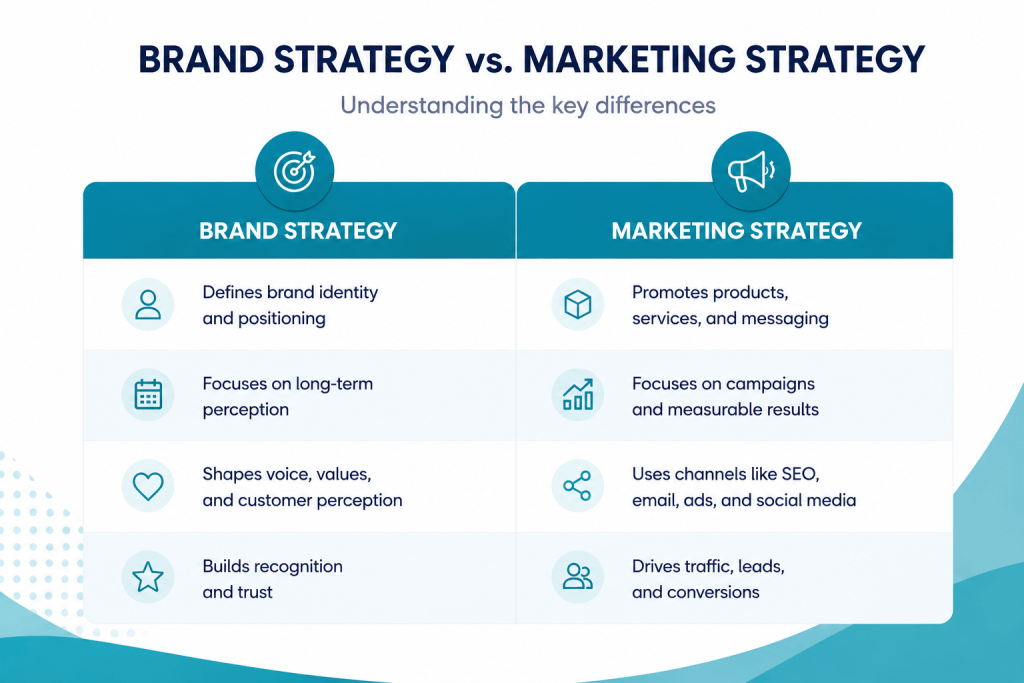
When comparing marketing strategy vs. brand strategy, the key difference comes down to identity versus promotion. Brand strategy defines who a business is, what it stands for, and how it wants to be perceived, while a marketing strategy focuses on how that message is communicated to attract, convert, and retain customers.
In other words, brand strategy shapes perception, while marketing strategy drives visibility and engagement. Understanding the difference between brand vs. marketing strategy helps businesses create more consistent messaging and stronger long-term growth.
What Is a Brand Strategy?
A brand strategy is a long-term plan that helps companies shape a memorable identity and stand out in an increasingly competitive market. By defining a company’s values, personality, positioning, and differentiation, this strategy guides everything from messaging and customer experiences to sales materials and internal alignment.
When applied consistently across every channel, brand strategy agencies help businesses create a cohesive voice, build trust with their audience, and support brand discovery.
Core Elements of a Strong Brand Strategy
There are various components that make up brand strategy services, including:
- Purpose and values: This is the “why” that drives your company. Beyond business objectives, your brand purpose guides internal decision-making and shows customers that your company stands for something meaningful.
- Target audience and buyer insights: If you’re not sure who your customers are, it’s nearly impossible to connect with them effectively. Identifying their unique demographics, behaviors, and pain points helps you engage with them in a more authentic way.
- Positioning and differentiation: What sets you apart from the competition? This may be your commitment to sustainability, a more competitive price point, or quality that outperforms others. These differentiators shape your messaging across channels.
- Messaging pillars: These are the key themes and statements that reinforce your core message. They act as a repeatable messaging framework that communicates what your brand stands for.
- Brand voice and tone principles: A company’s brand voice should resonate with its target audience. For example, a B2B brand strategy focused on business decision-makers will sound very different from a B2C strategy designed for a younger crowd.
- Visual and experiential direction: Your logo, color palette, typography, and digital experiences all work together to reflect your company’s values. Keeping these elements consistent across channels helps customers remember your brand.
- Internal alignment: If teams aren’t aligned on brand direction, your website, social media, emails, and other customer touchpoints can feel inconsistent. Over time, this can weaken brand recognition, trust, and loyalty.
What Is a Marketing Strategy?
A marketing strategy is a detailed action plan designed to reach, engage, convert, and retain a company’s target audience. Using different channels and campaigns, a marketing strategy turns brand direction into measurable activity across SEO, content marketing strategy services, paid media, social media, email marketing, lead generation, and website experiences.
For a B2B marketing strategy, this may include nurturing campaigns like email sequences and webinars, while a B2C strategy may focus more on emotional engagement and faster purchasing decisions.
Marketing Strategy Examples
To better understand what a marketing strategy includes, let’s take a look at some common examples:
- SEO: SEO services involve keyword research, link building, landing pages, technical optimization, and content creation to increase online visibility and attract qualified traffic.
- Copywriting: SEO copywriting services help execute the broader marketing strategy by creating optimized content that supports search rankings, engagement, and conversion goals across channels.
- PPC: PPC services help businesses capture demand for specific products, services, or offers through targeted paid advertising campaigns.
- Social media: Social media management services include everything from content planning and captions to graphic design, publishing, community management, and performance tracking.
- Lead generation: Lead generation services focus on attracting and converting potential customers through tactics like landing pages, email campaigns, webinars, and CRM workflows.
- GEO: GEO services help businesses optimize content for AI-powered search experiences, improving visibility across generative engines, AI summaries, and conversational search results to increase brand discovery and qualified traffic.
Brand Strategy vs. Marketing Strategy: Key Differences
Want a quick breakdown of the brand strategy vs marketing strategy difference? The table below explains it all:
| Element | Brand Strategy | Marketing Strategy |
| Purpose | Defines who the company is, what it stands for, and how it should be perceived. | Promotes products, services, and messaging to attract and convert customers. |
| Timeframe | Long-term focus centered on brand growth and recognition. | Short- to mid-term focus driven by campaigns, goals, and performance. |
| Main Question | “Who are we as a brand?” | “How do we reach and convert our audience?” |
| Owner | Brand strategists, leadership teams, creative directors, and digital marketers focused on positioning and messaging. | Marketing managers, digital marketers, SEO specialists, and growth teams focused on campaign execution and performance. |
| Outputs | Brand positioning, messaging frameworks, voice guidelines, and visual identity. | SEO campaigns, content marketing strategy services, paid ads, email campaigns, and social media content. |
| Channels | Influences all customer touchpoints and internal communication. | Uses channels like SEO, PPC, email marketing, social media, and websites. |
| Metrics | Brand awareness, recognition, customer trust, and loyalty. | Traffic, leads, conversions, engagement, ROI, and revenue growth. |
| Example | Defining a company as an innovative, eco-conscious technology brand. | Running SEO and PPC campaigns to promote a new software product launch. |
| Risk if Not Implemented | Inconsistent messaging, weak differentiation, and low brand recognition. | Poor visibility, low lead generation, and underperforming campaigns. |
Marketing and Branding Strategy: What to Bundle and What to Separate
We’d be lying if we said marketing and branding strategies weren’t connected. However, knowing what to bundle together and what to keep separate is often the difference between an okay strategy and one that drives long-term growth.
Here’s what you should know:
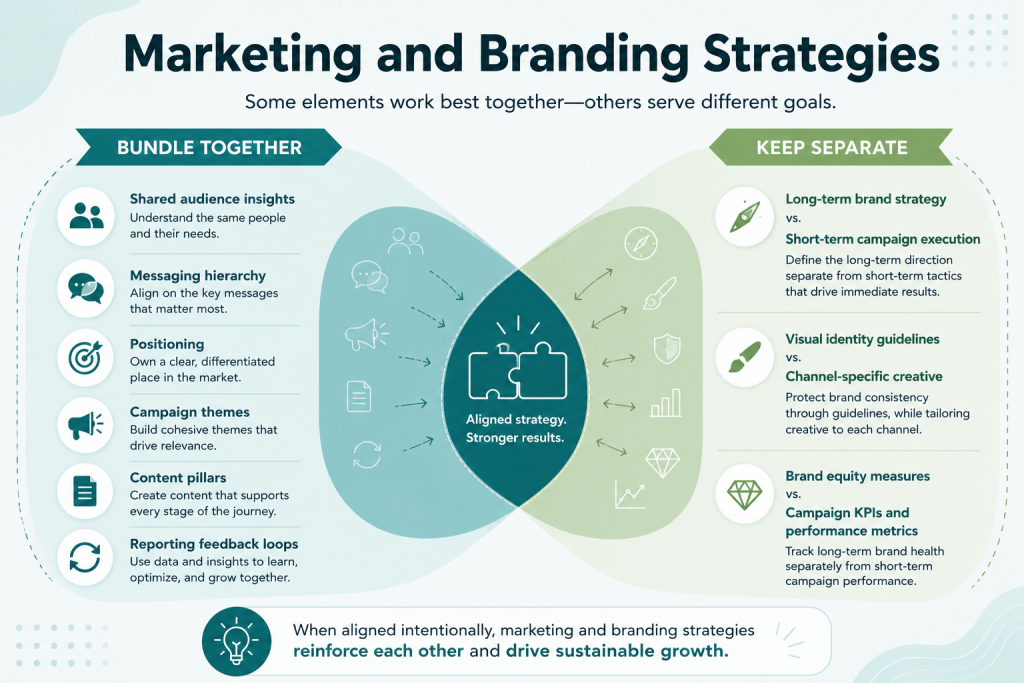
Full-service agencies support both marketing and branding strategies, helping businesses create a more connected and consistent customer experience.
Curious what this could look like for your company? Reach out to our team for a tailored strategy.
How Brand Strategy and Marketing Strategy Work Together
Brand strategy sets the direction; marketing brings that strategy to life in front of the right audience. While branding and brand strategy define how a company should be perceived, marketing focuses on communicating that identity across channels in a way that drives engagement and conversions.
To better understand how these strategies work together, let’s take a look at an example:
Not working together: Your marketing strategy successfully grabs the attention of potential customers; in this example, let’s say your audience consists of young adults interested in an innovative company. But when they click on the paid ad, email, or social media post, they land on a website filled with technical jargon and messaging that feels completely different from the campaign. The disconnect happens because the company’s brand and branding strategies are not aligned with its marketing execution.
Working together: Now imagine that same audience clicks through to a website that reflects the same tone, messaging, and visual identity as the original campaign. Not only does the marketing capture attention, but the branding reinforces trust by speaking to the audience consistently across every touchpoint. The result is a more cohesive customer experience that supports stronger engagement and conversions.
See the difference? One experience feels disconnected, while the other builds trust and reinforces the brand at every stage. That’s why successful businesses align branding and marketing efforts through a connected strategy framework like the one below.

Brand Tone vs. Voice in Marketing Communication Strategy
A brand’s voice is its consistent personality, the style and feeling people associate with the company across every interaction. Tone is more flexible and changes depending on the audience, channel, or situation.
For example, a brand may sound more conversational on social media, more polished in a sales deck, and more supportive in customer service emails, while still maintaining the same overall identity.
This is why tone and voice matter so much in a marketing communication strategy. Social media posts, emails, landing pages, ad copy, sales decks, and customer support scripts should all feel connected to the same brand, even when the tone shifts slightly for different audiences or platforms.
Common Mistakes When Teams Confuse Brand and Marketing Strategy
Worried your branding and marketing strategies aren’t aligned? Many businesses experience it firsthand.
Here are some of the most common mistakes teams make:
- Inconsistent campaigns: Marketing efforts feel disconnected because the brand foundation is unclear.
- Vague brand guidelines: Brand rules exist but don’t clearly guide content, sales, or campaign decisions.
- Short-term thinking: Teams focus on clicks and conversions while weakening long-term trust and recognition.
- Disconnected messaging: Different channels communicate different messages, leading to weak brand recall.
- Treating branding as one-time work: Branding is viewed as a project instead of an ongoing strategic system.
When Do You Need a Brand Strategy Agency or a Marketing Partner?
Not every business needs the same type of support. Some companies need help defining their identity, while others need help turning that strategy into consistent marketing execution.
You may need a brand strategy agency if you have:
- Unclear positioning or messaging
- Weak differentiation from competitors
- An upcoming rebrand or market expansion
- Inconsistent communication across channels
- B2B sales friction caused by unclear value propositions
You may need a full-service marketing partner if:
- SEO, content, PPC, social, and email efforts feel disconnected
- Website performance and lead generation need improvement
- You want stronger alignment across campaigns and channels
- Your business is focused on visibility, engagement, and measurable growth
This is where full-service marketing partners like Scopic Studios can help. Our team connects strategy, content, campaigns, and website experiences to create a more cohesive customer journey.
How Scopic Studios Can Support a Brand-Led Marketing Strategy
Even the strongest marketing campaigns can fall short when messaging, channels, and website experiences aren’t aligned with the brand foundation.
As an AI digital marketing agency, Scopic Studios helps businesses connect strategy and execution through integrated support across SEO, content, PPC, social media, email marketing, AI visibility, lead generation, and website optimization. When every touchpoint works together, marketing becomes more consistent, recognizable, and effective.
Need help turning strategy into measurable marketing execution? Talk to our team at Scopic Studios.
FAQs About Brand Strategy vs. Marketing Strategy
What is the difference between brand strategy and marketing strategy?
Brand strategy defines a company’s identity, positioning, and long-term meaning, while marketing strategy focuses on how the brand reaches, engages, and converts its audience through campaigns and marketing channels. Together, these strategies help businesses create both a recognizable identity and measurable growth.
Which comes first, brand strategy or marketing strategy?
Brand strategy should come first because it gives marketing a clear foundation to build from, including audience insights, positioning, messaging, and brand voice. Without that direction, marketing campaigns can quickly become inconsistent or disconnected.
Can you have a marketing strategy without a brand strategy?
Yes, but it often creates inconsistent or short-term campaigns that lack a clear identity. Without a strong brand foundation, marketing efforts may feel generic and struggle to build long-term trust or recognition.
What should be included in a brand strategy?
A strong brand strategy typically includes a company’s purpose, values, audience insights, positioning, differentiation, messaging pillars, brand voice, tone principles, and decision-making guidelines. Together, these elements help create a more consistent and recognizable brand identity across channels.
What should be included in a marketing strategy?
A marketing strategy should include business goals, target audience insights, channel selection, campaign planning, content strategy, budget allocation, conversion paths, KPIs, reporting processes, and optimization plans. These elements help businesses measure performance and improve marketing effectiveness over time.
How do branding and brand strategy differ?
Brand strategy defines what a company wants the brand to represent, while branding translates that strategy into visual, verbal, and experiential elements like messaging, design, tone, and customer experiences. In short, strategy defines the direction, while branding brings that direction to life.
When should you hire a brand strategy agency?
A business may benefit from a brand strategy agency when positioning feels unclear, messaging is inconsistent, differentiation is weak, or the company is preparing for a rebrand, market expansion, or major growth phase. Strong brand strategy support can also help businesses create more aligned marketing and sales experiences.
How can a full-service digital marketing agency support brand strategy?
A full-service digital marketing agency helps bring brand strategy to life by translating the brand foundation into consistent SEO, content, PPC, social media, email marketing, lead generation, website, and AI visibility efforts across channels. This creates a more connected customer experience and helps reinforce the brand across every touchpoint.
About Brand Strategy vs Marketing Strategy Guide
This guide was authored by Baily Ramsey, and reviewed by Sonja Somborac, SEO Specialist at Scopic Studios.
Scopic Studios delivers exceptional and engaging content rooted in our expertise across marketing and creative services. Our team of talented writers and digital experts excel in transforming intricate concepts into captivating narratives tailored for diverse industries. We’re passionate about crafting content that not only resonates but also drives value across all digital platforms.