Listen to article
What’s your company’s main goal?
While there are so many ways to answer this question, we’ll answer it from a digital marketing perspective: to help our clients gain better online visibility that attracts traffic, improves brand awareness, and increases conversions.
If you asked us a year ago, we would say that SEO is our go-to strategy for achieving this. And while still true, another approach is quickly gaining popularity for boosting online visibility, except this time for AI-driven search engines: GEO.
With search habits constantly evolving, the discussion of GEO vs. SEO is ever-important. That’s why we’re laying it all out, covering the key differences, similarities, and how to use SEO and GEO together for greater visibility.
Key Takeaways
- GEO focuses on gaining visibility in AI search engines by appearing in AI-generated answers, while SEO works to improve organic rankings in traditional search results.
- GEO success is measured by citations in AI-generated answers, response accuracy, and AI-driven engagement, while SEO success is tracked through metrics like organic traffic, conversions, keyword rankings, and user behavior data.
- GEO prioritizes clear, conversational, and up-to-date answers in formats like FAQs, listicles, and how-tos, while SEO emphasizes depth, keyword optimization, and comprehensive content such as guides, pillar pages, and case studies to improve visibility.
- SEO and GEO share several core elements, including user intent, authority, quality content, strong content structure, a solid technical foundation, and ongoing optimization.
- When used together, SEO and GEO complement each other to expand reach, strengthen visibility across both traditional and AI-driven search, and keep your brand ahead as search habits evolve.
What is Search Engine Optimization (SEO)?
Search engine optimization (SEO) is the practice of optimizing a website’s content, structure, and authority to improve its visibility and rankings in search engine results. By implementing strategies like on-page SEO, high-quality content creation, link building, technical optimization, and local SEO, businesses can successfully attract qualified traffic.
What is Generative Engine Optimization (GEO)?
Generative engine optimization, or GEO, is the process of optimizing content so it can be found and displayed by AI-driven search engines, such as Google’s AI Overview, ChatGPT, and Perplexity. Through LLM optimization, companies create authoritative content, structure information for AI systems, and keep content up to date to improve their chances of being cited in AI-generated answers.
Understanding GEO vs. SEO with a Real Search Example
Let’s take a quick look at how SEO and GEO appear on Google. As someone recently interested in composting, let’s say I look up “best practices for composting.”
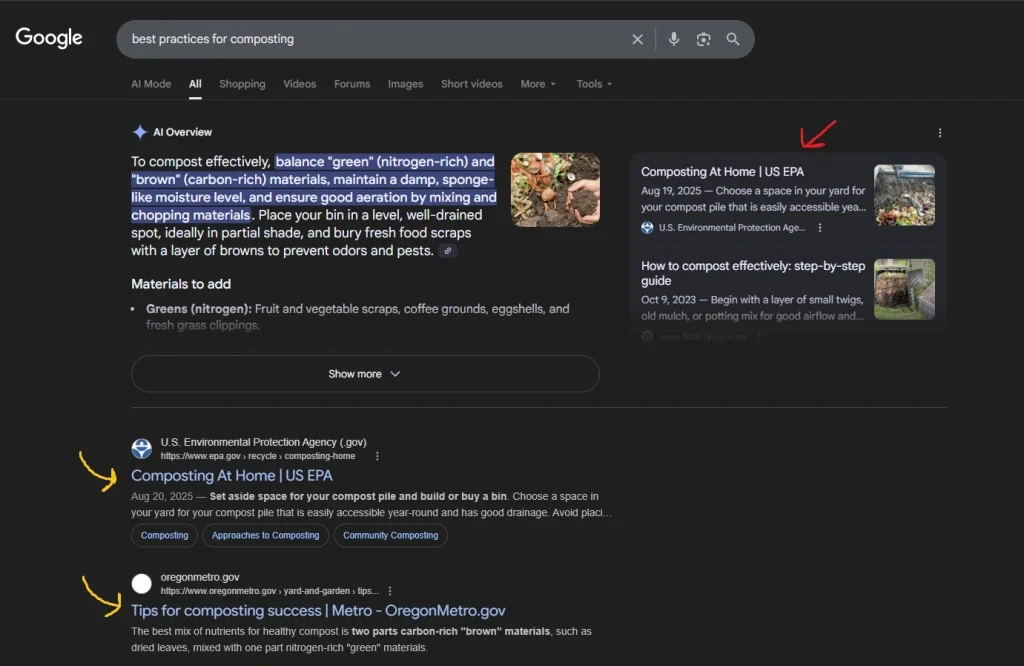
The first thing we see is an AI Overview, which provides a quick summary of how to compost. As shown by the red arrow, it also includes links to its sources. The goal of GEO is to have your website featured here.
The yellow arrows highlight what’s ranking in Google’s organic results. This is where your content shows up when SEO is working. The goal of SEO is to earn a spot in these listings.
GEO vs. SEO: Key Differences
While GEO and SEO do have similarities (which we’ll discuss below), they also have key differences:
|
Category |
GEO | SEO |
| Primary Goal | Visibility in AI-driven search engines | Improve organic rankings in traditional search engines |
| Strategies | Authoritative content, conversational queries, clear structure, and technical optimization | On-page SEO, link building, technical SEO, and local SEO |
| Metrics of Success | AI answer citations, accuracy of responses, and engagement from AI-sourced traffic | Organic traffic, conversions, keyword rankings, CTR, exit rate, and pages per session |
| Optimization Target | Large language models and AI search like Google AI Overview, ChatGPT, and Perplexity | Search engine algorithms like Google, Bing, and Yahoo |
| Content Structure | Direct, clear, up-to-date answers; FAQs, listicles, how-tos, summaries | In-depth, keyword-driven content; guides, pillar pages, landing pages, case studies, long-form blogs |
Primary Goal
GEO: The goal of generative engine optimization is to gain visibility in AI-driven search engines. Since around one in five Google searches in March 2025 produced AI summaries, this visibility helps companies get cited and reach users directly where they search for answers.
SEO: The goal of SEO is to increase organic rankings in search engines. With around 94% of all webpages receiving no traffic from Google, having a comprehensive SEO strategy helps your company stand out in a competitive digital landscape.
Strategies & Optimization Approaches
GEO: Common GEO strategies include creating authoritative content, using clear headlines and bullet points, optimizing for conversational queries, keeping content up to date, and applying technical optimizations such as schema markup and metadata.
SEO: Common SEO strategies include on-page SEO, link building, technical SEO, and local SEO, among others. Check out our SEO services to better understand how each of these approaches contributes to a well-rounded SEO strategy.
Metrics of Success
GEO: You can measure the success of your GEO strategy by evaluating how often your content is cited in AI-generated answers, accuracy of responses, and engagement driven from AI-sourced traffic.
SEO: Key SEO metrics include organic traffic and conversions, keyword rankings, click-through rate, exit rate, and pages per session.
Optimization Target
GEO: GEO targets large language models and AI search engines, such as Google AI Overview, ChatGPT, and Perplexity.
SEO: SEO targets search engine algorithms, such as Google, Bing, and Yahoo.
Content Structure
GEO: GEO prioritizes direct, clear, up-to-date, and authoritative answers. A key part of this strategy is optimizing for conversational queries, which involves aligning your content with how people actually speak and ask questions. Common content formats include FAQs, listicles, how-tos, and summaries.
SEO: While SEO also values clarity and accuracy, it often emphasizes depth, keyword optimization, and comprehensive coverage of a topic. Content structures may include long-form guides, pillar pages, landing pages, case studies, and detailed blog posts that not only answer the immediate query but also address related subtopics to improve search visibility.
What Traditional SEO and GEO Have in Common
Now that we know the key differences between GEO vs. SEO, let’s take a look at what they have in common:
User Intent & Relevance
Whether you’re crafting a GEO strategy for the first time or updating your existing SEO strategy, one of the key things they have in common is that user intent matters. If your content is vague and doesn’t match the keyword or phrase users are searching for, then it most likely won’t rank on search engines or AI-driven search platforms.
For example, let’s say someone searches “affordable CRM tools for startups.” If your page only explains what CRM tools are or focuses on enterprise-level solutions without naming affordable options, it won’t match the intent and therefore won’t be prioritized in search rankings or AI-driven answers.
Authority and Trustworthiness
Both GEO and SEO strategies require authoritative content that inspires trust. E-E-A-T, which stands for Experience, Expertise, Authoritativeness, and Trustworthiness, is a set of guidelines used to assess the overall quality of web content.
Experienced marketers have used this approach for years to boost SEO rankings, and now it also plays a key role in a successful GEO strategy. To improve your company’s E-E-A-T, you can incorporate real-life examples, use technical terminology correctly, highlight relevant qualifications, cite reputable sources, and provide clear attribution.
Quality Content
Put simply, if you don’t want to read low-quality content, then neither do other readers nor AI machines.
That said, your content should be original and well-researched, include up-to-date statistics, and maintain proper spelling and grammar.
At Scopic Studios, we create authentic and high-quality content that drives traffic. Contact us to learn how we can help you create on-brand articles, landing pages, and more.
Content Structure
The structure of your content helps you achieve better visibility in SEO and GEO alike. You should structure your content in a way that’s easy to read, such as using headers, bullet points, and breaking paragraphs into shorter, scannable sections.
Lists and tables also make information easier to scan, with visuals and internal links simplifying complex ideas and connecting related topics.
Technical Foundation
Optimizing for GEO and SEO goes beyond content quality and structure. The technical foundation of your website also plays a huge role in user experience and determines how easily both search engines and AI systems can crawl, interpret, and surface your content.
Websites with fast loading times, clean URLs, and mobile responsiveness perform better for both SEO and GEO.
Ongoing Optimization
GEO and SEO both require ongoing optimization to ensure your content stays relevant and visible. By reviewing performance metrics, you can better understand what works and what doesn’t, giving you a clear path to adjust your strategy and boost rankings even further.
Effective optimization includes both on-site updates—such as refreshing content, replacing outdated statistics, and restructuring pages for better search performance—and off-site signals, including building high-quality backlinks, increasing brand mentions, and strengthening domain authority. Together, these efforts help search engines recognize your site as credible, authoritative, and worth ranking.
How SEO and GEO Work Together for Greater Online Visibility
While SEO and GEO have key differences, they can be used together to improve your online presence.
Think of it this way: We now know that the goal of SEO is to rank in traditional search results, while GEO focuses on appearing in AI-driven search engines. While these are clearly distinct goals, they both contribute to one thing: greater online visibility.
So should they be used separately or in unison?
While each company must decide that for themselves, we personally believe that SEO and GEO work even better when used together.
This is because SEO strengthens your long-term foundation, while GEO helps you take advantage of modern search habits. When you combine these approaches, they ensure your brand is visible not only in traditional results but also in emerging AI-powered answers.
5-Step Process: Integrating SEO and GEO Into Your Workflow
Have an SEO strategy and want to incorporate GEO? Just starting your digital marketing journey with no strategy in place yet?
Here’s a 5-step process to help you get started:
1. Start with a Strong SEO Foundation
First things first: Optimize for SEO. Why?
Because many of the areas SEO focuses on are also beneficial for GEO.
To accomplish this, you should conduct keyword research, apply on-page optimization, and build off-page authority. By applying SEO best practices, you can improve rankings in traditional search engines while also laying the groundwork for GEO initiatives.
2. Optimize for Technical Performance
You can have the best content in the world, but if your website is slow and not mobile-friendly, you risk losing visitors, rankings, and visibility.
Optimizing your site architecture is one of the first technical updates you should make. In addition to improving user experience, this improves crawlability, meaning search engines can access and navigate your website’s pages.
Other key factors include secure HTTPS protocols, clean URLs, schema markup, and XML sitemaps. Together, these elements make your site both search-engine friendly and AI-ready.
3. Create Content that Matches Both SEO and GEO
As mentioned, SEO and GEO both prioritize scannable content, which includes using headers, bullet points, and short paragraphs.
In addition, companies can optimize for SEO and GEO by using relevant keywords strategically, answering questions clearly and directly, targeting long-tail keywords to capture conversational queries, and incorporating FAQ sections.
4. Distribute Content Across Search and AI Platforms
Creating great content is only half the battle; distribution ensures it’s seen. For SEO, this means publishing content on your website, optimizing it for Google and Bing, and promoting it through channels like social media and backlinks.
For GEO, it includes ensuring your content is accessible to AI-driven platforms such as Google AI Overview, Perplexity, and ChatGPT by using structured data, FAQs, and multimedia elements that AI can parse.
The wider your reach, the greater your visibility in both SEO and GEO. This not only expands your audience but also increases the chances of being cited or ranked where users are searching.
5. Measure Results and Refine Strategy
Are you ranking in search engines? Being cited by large language models?
If not, it’s time to adjust your strategy. Analyze the performance metrics we discussed above (such as keyword rankings, organic traffic, and AI citations) to improve your strategy.
This requires careful evaluation of your content and website performance. For example, if you notice your content doesn’t answer questions directly or use conversational keywords, you can make updates to optimize your blogs further for AI search engines.
How to Know If You Need GEO, SEO, or Both
Choosing the right approach depends on your goals, audience, and how people are searching for your business. Here’s a simple roadmap:
- You want to increase overall visibility → GEO & SEO
- You only want to focus on organic search rankings → SEO
- You only want brand mentions and citations in AI summaries → GEO
- You want to future-proof your visibility → GEO & SEO
- You want to ensure people actually click through to your website → GEO & SEO
- You want to capture users wherever they search → GEO & SEO
Common Misconceptions About GEO vs. SEO
When we hear “Geo vs. SEO,” we’re programmed to think that there’s some sort of competition between the two.
This is far from the truth, and we’re here to clarify something important.
The myth that SEO is dead is exactly that—a myth. GEO is not meant to replace SEO but rather build on it to reach even more individuals.
Some companies may feel discouraged because their SEO rankings have declined since the release of Google AI Overviews, for example. And while this is a reality for many companies, it’s also the perfect time to reevaluate your strategy.
In fact, the digital landscape is constantly evolving, and for the same reasons, marketing strategies must stay agile to adapt to new technologies, shifting user behaviors, and emerging search platforms.
Those who embrace both GEO and SEO now will not only protect their visibility but also gain a competitive edge as search continues to evolve.
Final Thoughts
At the end of the day, it’s not just about knowing the differences between GEO vs. SEO but also understanding how they fit together.
While SEO lays the groundwork by helping you rank in traditional search engines, GEO makes sure your content shows up in AI-driven answers. In other words, they’re not competing strategies; they’re partners.
When you use them side by side, you boost visibility, reach more people, and stay ahead of evolving search habits.
At Scopic Studios, we support businesses in both SEO and GEO by staying ahead of industry trends, keeping your brand visible now and as search continues to evolve.
Contact us today for a tailored strategy.
FAQs about SEO vs. GEO
What is the difference between GEO and SEO?
SEO focuses on improving rankings in traditional search engines, while GEO aims to increase visibility in AI-driven search engines and responses.
Do I need GEO if I already do SEO?
Yes. While SEO builds your foundation in traditional search engines, GEO complements it by making sure your content is also visible and cited in AI-driven search platforms.
Does GEO replace SEO?
No, GEO does not replace SEO; it builds on it. Both work together to maximize visibility across traditional and AI-driven search engines.
How long does GEO optimization take compared to SEO?
GEO and SEO rely on different ranking and citation factors, and the time it takes to see results depends on the actions performed and how quickly each platform’s algorithm or model responds. In both cases, ongoing optimization is essential for maintaining long-term visibility.
About GEO vs. SEO Guide
This guide was authored by Baily Ramsey, and reviewed by Assia Belmokhtar, SEO Project Manager at Scopic.
Scopic Studios delivers exceptional and engaging content rooted in our expertise across marketing and creative services. Our team of talented writers and digital experts excel in transforming intricate concepts into captivating narratives tailored for diverse industries. We’re passionate about crafting content that not only resonates but also drives value across all digital platforms.